

















Choosing the right mattress can feel overwhelming when you're faced with three main types: hybrid, foam, and innerspring. Each option offers different benefits based on how it's built and what materials are used. Understanding these differences helps you match a mattress to your sleep style, body type, and budget.
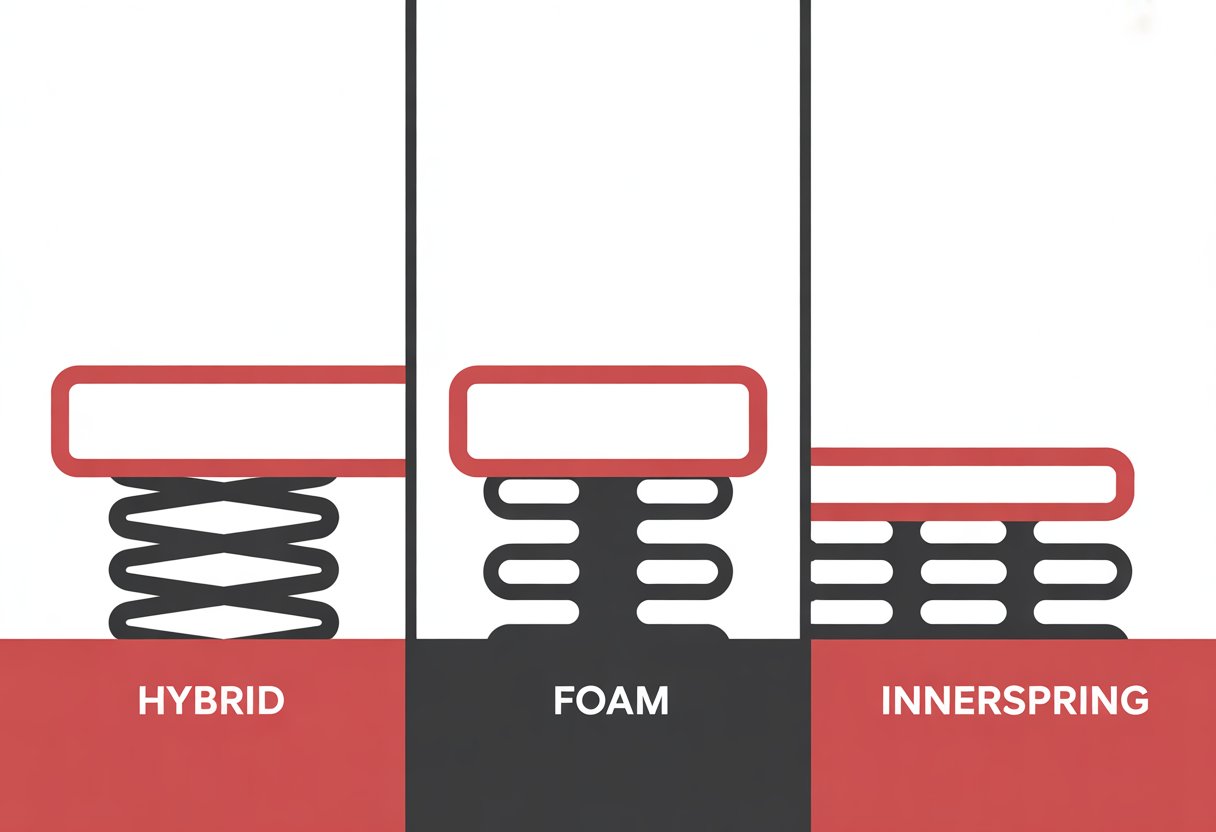
Hybrid mattresses combine coil support with foam comfort layers, foam mattresses contour closely to your body for pressure relief, and innerspring mattresses provide a bouncy feel with traditional coil systems. Memory foam limits motion transfer better than spring options, making it good for couples. Meanwhile, hybrid and innerspring mattresses handle humidity better due to their coil systems.
Your ideal choice depends on whether you prioritize pressure relief, cooling, support, or price. This guide breaks down how each mattress type performs across key factors so you can make a confident decision.
Key Takeaways
- Hybrid mattresses balance support and comfort while foam contours to your body and innerspring provides affordable bounce
- Temperature regulation varies with foam trapping more heat and coil-based mattresses offering better airflow
- Your sleep position and body type determine which mattress construction will give you the best support and comfort
Hybrid, Foam, and Innerspring Mattresses Explained
Each mattress type uses different materials and construction methods that affect how you sleep. Foam mattresses rely on layers of cushioning material, innerspring mattresses use metal coils for support, and hybrid mattresses combine both approaches.
What Are Foam Mattresses?
Foam mattresses are built entirely from foam layers without any springs or coils. Most all-foam mattresses include multiple layers stacked together. You'll find a dense base layer at the bottom for support, a middle layer that contours to your body, and a top comfort layer.
Common types of foam include:
- Memory foam – Moulds to your body shape and provides pressure relief
- Polyurethane foam – A versatile material used in many mattress types
- Latex foam – Made from rubber tree sap and offers natural bounce
Memory foam mattresses excel at reducing motion transfer, which means you won't feel your partner moving during the night. These mattresses conform closely to your body, providing targeted support for pressure points like your shoulders and hips.
The main drawback is heat retention. Foam can trap body heat, making these mattresses warmer than other options.
What Are Innerspring Mattresses?
Innerspring mattresses feature a support system made of steel coils covered by padding and fabric layers. The coil gauge determines firmness—lower gauge numbers mean thicker, firmer coils.
You'll encounter several coil types. Bonnell coils are hourglass-shaped and affordable but less durable. Offset coils connect at the top and bottom for better durability. Continuous coils use one long wire shaped into S-curves. Individually wrapped springs are encased in fabric, allowing better motion isolation and support.
Innerspring mattresses sleep cooler than foam because air flows freely between the coils. They cost less than other mattress types and provide firm, responsive support.
However, they offer less pressure relief than foam and can sag over time if you sleep in the same position every night.
What Are Hybrid Mattresses?
A hybrid mattress combines an innerspring coil base with multiple foam comfort layers on top. This construction gives you the supportive bounce of springs plus the pressure relief of foam.
The biggest difference is the amount of cushioning compared to traditional innerspring beds. Hybrid mattresses include transition layers between the coils and top surface that add comfort and support.
These mattresses work well for combination sleepers who change positions throughout the night. The coils provide responsive support when you move, while the foam layers cushion your body. Hybrid mattresses typically last longer than all-foam options because the coils prevent sagging.
The downsides include higher prices and heavier weight, making them harder to move or rotate. Most hybrids also need to off-gas before use, similar to foam mattresses.
Construction and Key Materials
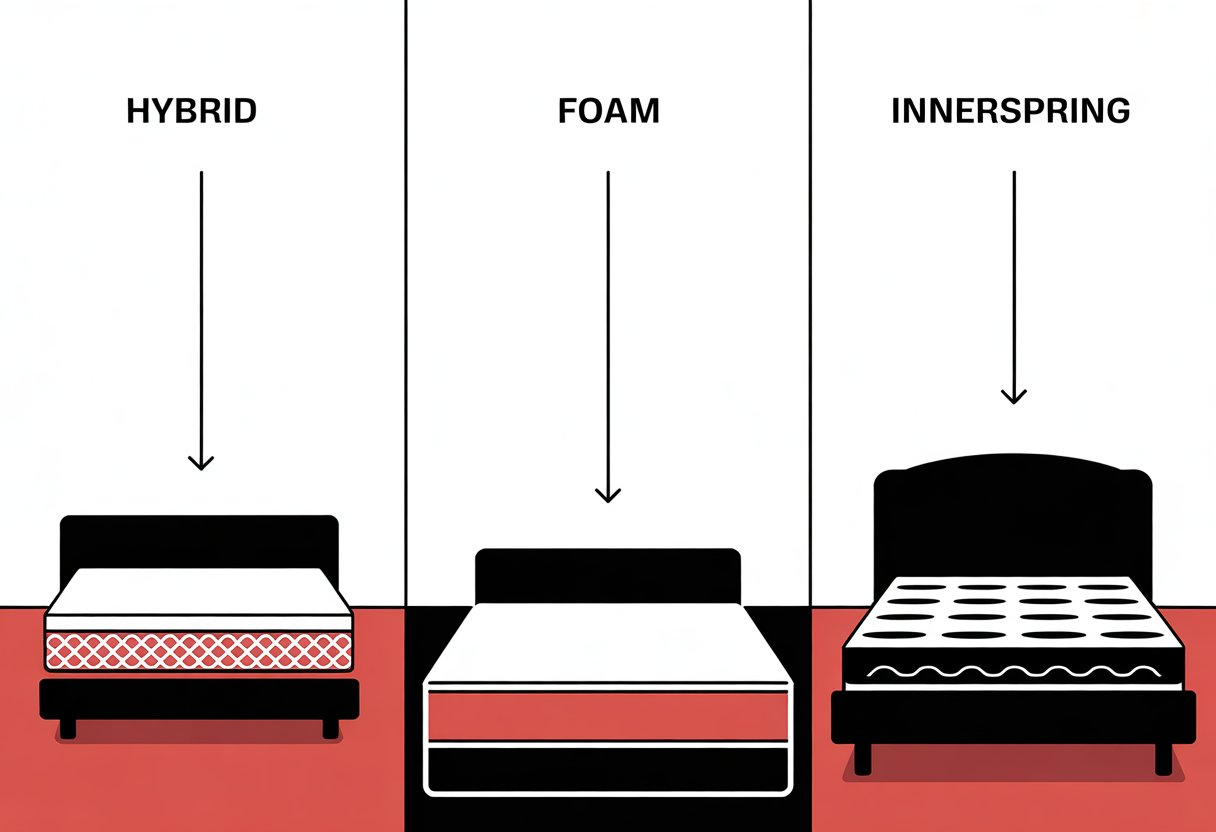
Each mattress type uses different materials and building methods that affect how they feel and perform. Foam mattresses rely entirely on layered foam, innerspring beds use metal coils with thin padding, and hybrids combine both approaches.
Foam Mattress Layers and Density
Foam mattresses stack multiple foam layers to create support and comfort. The comfort layer sits on top and provides cushioning where your body makes contact. Below that, a transition layer helps distribute weight evenly and prevents you from sinking too far into the bed.
The base layer provides the main support structure. Most all-foam beds use at least three layers to balance softness and support.
Foam density measures how much material is packed into each cubic foot. Higher density foam (5 pounds per cubic foot or more) lasts longer but sleeps warmer. Lower density foam (3 pounds per cubic foot or less) feels softer and breathes better but wears out faster.
Common foam types include:
- Memory foam - conforms closely to your body shape
- Poly-foam - offers basic support at lower costs
- Latex foam - provides bounce and natural cooling
- Gel-infused foam - adds cooling gel particles to reduce heat
- Open-cell foam - uses larger air pockets for better airflow
Natural latex comes from rubber tree sap and tends to be more durable than synthetic options.
Innerspring Coils and Comfort Layers
Innerspring mattresses build their support around a coil system made of metal springs. The coil gauge (wire thickness) ranges from 12 to 15, with lower numbers meaning thicker, firmer coils. Coil count varies from 300 to over 1,000 springs, though more coils don't always mean better support.
Different coil types change how the bed responds:
- Bonnell coils - hourglass-shaped springs connected in a grid
- Offset coils - hinged coils that conform better to body shape
- Continuous coils - single wire formed into multiple springs
- Pocketed coils (pocket coils) - individually wrapped coils in fabric sleeves
Individually wrapped coils reduce motion transfer better than connected systems. The coil support core makes up most of the mattress height.
Traditional innerspring beds add only thin comfort layers of padding or wool on top. Some models include a pillow top or euro top sewn onto the surface for extra cushioning.
Hybrid Mattress Components
Hybrid mattresses pair a coil support core with thick foam layers on top. The bottom uses pocketed coils (also called wrapped coils) to provide core support and airflow. These individually wrapped coils move independently to reduce motion transfer.
Above the springs, hybrid mattresses typically feature at least three inches of comfort materials. These layers often include memory foam, latex foam, or poly-foam in various combinations. Some models add gel-infused foam or open-cell foam for cooling.
The layered construction in a hybrid mattress creates more options for customisation than traditional innerspring beds. Quality hybrid mattresses use heavier gauge coils around the perimeter to strengthen edge support. This prevents sagging when you sit or sleep near the sides.
Performance Comparison: Pressure Relief, Support, and Motion
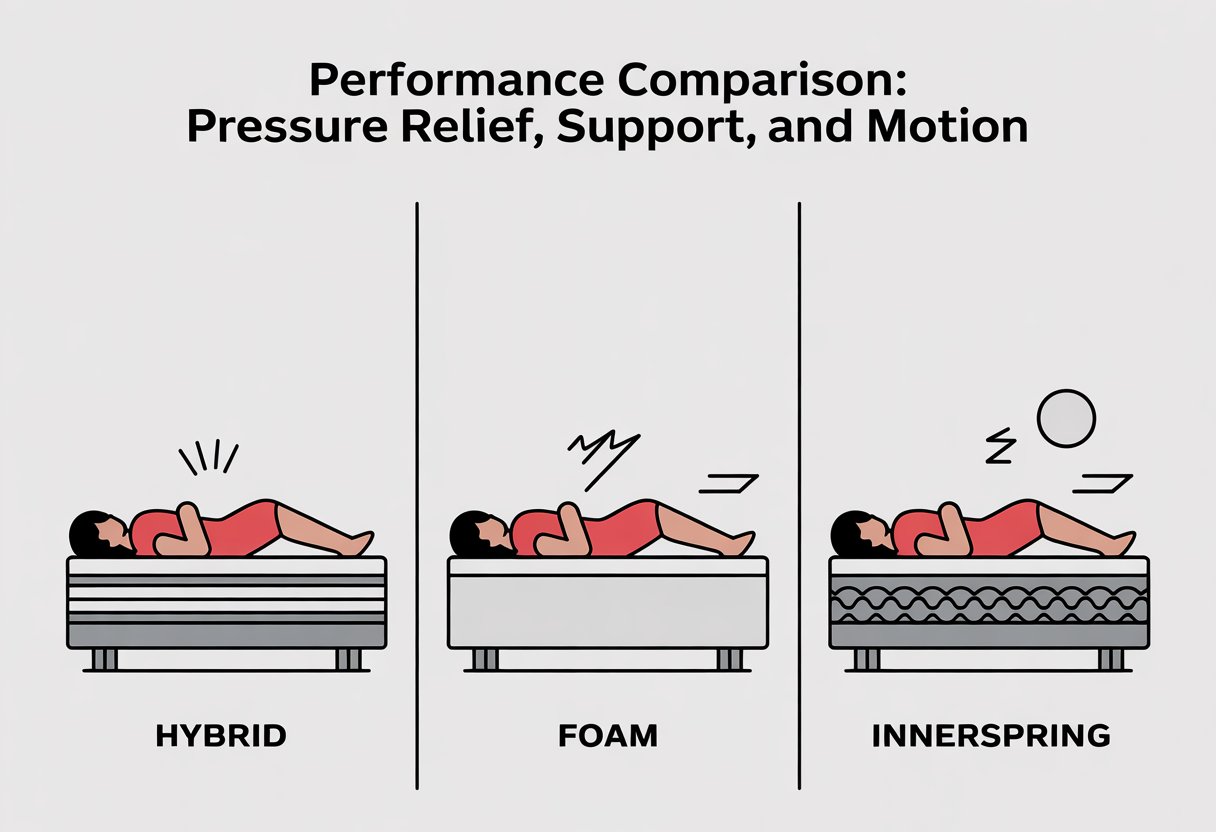
Memory foam mattresses excel at pressure relief and motion isolation, while innerspring models provide responsive support with better edge stability. Hybrid mattresses aim to balance these qualities by combining coil systems with substantial comfort layers.
Pressure Relief and Spinal Alignment
Memory foam provides the best pressure relief among the three mattress types because it contours closely to your body shape. The material responds to your weight and body heat, cushioning pressure points at your shoulders, hips, and knees. This makes memory foam particularly suitable if you sleep on your side.
Innerspring mattresses offer limited pressure relief due to their minimal comfort layers. The bouncy coil system keeps you lifted on the surface rather than allowing your body to sink in. This creates concentrated pressure on your shoulders, hips, and spine.
Hybrid mattresses fall between these two options. They provide better pressure relief than innerspring models but typically less than pure memory foam mattresses. The thick comfort layers cushion pressure points while the coil core maintains proper spinal alignment and lumbar support. Many premium hybrids include zoned support systems that provide firmer support under heavier body areas and softer cushioning at pressure points.
Motion Isolation and Motion Transfer
Memory foam absorbs movement exceptionally well, making it the best choice for motion isolation. When your partner moves or gets out of bed, you likely won't feel the disturbance. The dense foam material dampens motion transfer across the mattress surface.
Innerspring mattresses perform worst for motion isolation. Even pocketed coil designs transfer some movement across the sleep surface. Traditional interconnected coil systems are particularly problematic because motion travels through the connected springs. This can disrupt your sleep if you share the bed with a restless partner.
Hybrid mattresses leverage their foam layers to absorb motion while the individually wrapped coils move independently. This combination significantly reduces motion transfer compared to traditional innerspring designs, though hybrids still don't match the complete motion isolation of all-foam mattresses.
Edge Support and Sinkage
Innerspring mattresses typically feature the strongest edge support with reinforced perimeters that resist compression. You can sit on the edge without experiencing significant sinkage, which maximises the usable sleep surface. The coil system maintains its structure right to the mattress perimeter.
Memory foam mattresses often struggle with edge support because the foam compresses under concentrated weight. You may feel like you're rolling off the edge when sitting or sleeping near the perimeter. Higher-density foams and reinforced edges in premium models can improve this weakness.
Hybrid mattresses generally provide good edge support that falls between innerspring and foam options. The pocketed coil system extends to the edges, offering structural support while the foam layers add cushioning. This combination prevents the excessive sinkage common in all-foam designs whilst maintaining responsive support throughout the mattress surface.
Temperature Regulation and Breathability
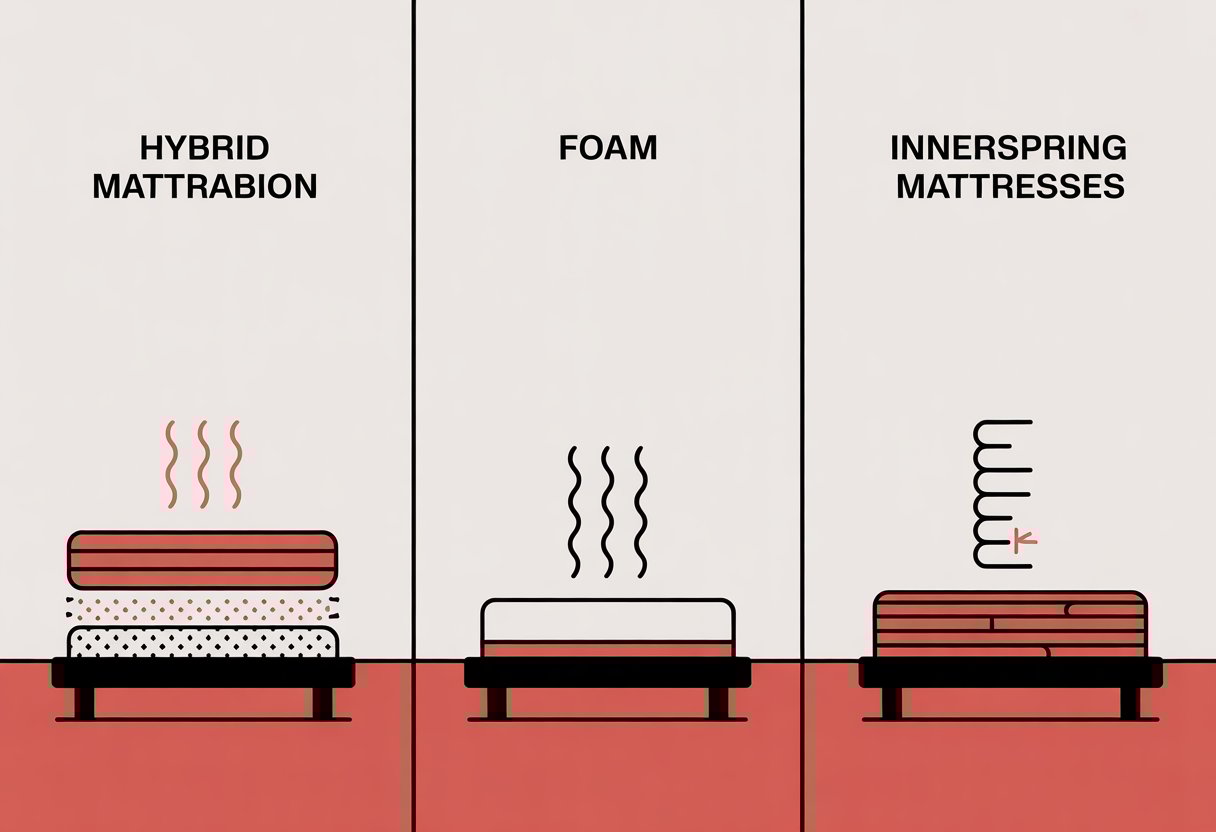
How well a mattress manages heat depends on its materials and construction. Innerspring mattresses sleep coolest due to open coil systems, while foam mattresses trap more heat, and hybrids fall somewhere in between.
Heat Retention and Airflow
Innerspring mattresses offer the best natural airflow because air moves freely through the coil system. The open spaces between coils allow heat to escape throughout the night. This makes innerspring beds ideal for hot sleepers who wake up sweating.
Traditional memory foam mattresses trap the most heat. The dense foam hugs your body closely, which blocks airflow and causes heat retention. You sink into the material, creating a warm pocket around your body.
Hybrid mattresses provide moderate breathability. The coil base allows some air circulation, but the foam comfort layers on top can still trap heat near your body. Hybrids with gel infusions and breathable foams help improve temperature control compared to solid foam designs.
Latex foam sleeps cooler than memory foam because it has a more open cell structure. Heat dissipation happens more quickly through latex, though it still doesn't match the airflow of innerspring coils.
Cooling Technologies and Materials
Modern mattresses include specific features to combat heat buildup. Gel-infused foams absorb and distribute body heat away from pressure points. Phase-change materials respond to temperature changes by absorbing excess warmth when you get hot.
Breathable cover fabrics also help with temperature regulation. Materials like cotton, Tencel, and moisture-wicking synthetics pull heat and sweat away from your skin. Some covers include ventilation panels or perforations for extra airflow.
Hybrid mattresses often layer cooling technologies for better results. A coil base provides airflow while gel foam or latex comfort layers reduce heat retention. Some designs add air channels or ventilation holes through the foam layers.
Innerspring mattresses with minimal padding stay coolest. Thick pillow tops reduce the natural breathability of the coil system, making these models sleep warmer than basic innerspring designs.
Suitability by Sleep Style and Body Type
Your sleeping position and body weight play major roles in determining which mattress type will give you the best support and comfort. Side sleepers need different pressure relief than back sleepers, whilst lightweight sleepers have distinct needs compared to heavier individuals.
Best Mattress Types for Side Sleepers
Side sleepers put concentrated pressure on their shoulders and hips throughout the night. These pressure points need cushioning to prevent pain and maintain proper spinal alignment.
Memory foam and hybrid mattresses work best for side sleepers because they contour to your body shape. Foam layers compress where your shoulders and hips press down, which helps keep your spine straight.
You should look for medium to medium-soft firmness options. A mattress that's too firm won't let your pressure points sink in enough. This creates gaps between your body and the mattress at your waist.
Key features for side sleepers:
- Thick comfort layers (at least 8-10 cm)
- Medium firmness (5-6 on a 10-point scale)
- Good pressure relief at shoulders and hips
Ideal Choices for Back and Stomach Sleepers
Back sleepers need balanced support that keeps their lower back from sagging. Your spine should maintain its natural curve without dipping at the hips or shoulders.
Innerspring and hybrid mattresses often suit back sleepers well. The coil support prevents excessive sinking whilst still providing some cushioning. Medium-firm to firm options (6-7 on firmness scales) typically work best.
Stomach sleepers face different challenges. Sleeping on your stomach can strain your neck and lower back if the mattress lets your hips sink too far.
Firm innerspring mattresses are usually the best choice for stomach sleeping. They keep your body level and prevent your midsection from creating a U-shape. You want minimal sinking to maintain proper alignment.
Recommended firmness by sleeping positions:
- Back sleepers: Medium-firm (6-7/10)
- Stomach sleepers: Firm (7-8/10)
Considerations for Combination and Lightweight Sleepers
Combination sleepers change positions throughout the night. You need a mattress that works well whether you're on your side, back, or stomach.
Hybrid mattresses offer the best balance for combination sleepers because they combine responsive coils with contouring foam layers. The springs make it easier to shift positions without feeling stuck.
Medium firmness works best since it accommodates multiple sleeping positions. You get enough cushioning for side sleeping but sufficient support for back or stomach positions.
Lightweight sleepers (under 60 kg) face unique challenges. You don't compress mattress layers as much as heavier individuals do. Firm mattresses can feel too hard because you don't sink in enough to reach comfort layers.
Foam mattresses with softer top layers suit lightweight sleepers well. You'll experience better contouring without needing as much body weight to compress the materials. Medium-soft firmness options (4-5/10) often feel more comfortable than firmer choices.
Durability, Off-Gassing, and Maintenance
Each mattress type has different longevity expectations and requires specific care practices. The materials used in construction affect both how long your mattress lasts and what maintenance it needs.
Lifespan and Longevity
Hybrid mattresses typically last 8-12 years because their steel coil systems resist sagging better than foam alone. The individually wrapped coils maintain their support structure while comfort layers may soften first.
Memory foam mattresses generally last 6-10 years. Higher-density foams (4-5 pounds per cubic foot) last longer than lower-density options. Temperature changes can affect foam over time, causing it to soften or develop permanent impressions in high-use areas.
Innerspring mattresses usually last 6-8 years. The connected coil system provides good initial support, but the thinner comfort layers compress faster than hybrid or foam alternatives. Traditional bonnell coils may develop squeaks or sagging as the steel fatigues.
Durability Factors:
- Body weight: Heavier sleepers compress materials faster
- Sleep position: Side sleepers create more pressure point wear
- Rotation schedule: Regular rotation extends lifespan by 2-3 years
- Foundation quality: Proper support prevents premature sagging
Off-Gassing and Initial Odours
Memory foam mattresses produce the strongest initial odour due to polyurethane foam manufacturing. Different mattress types release varying levels of volatile organic compounds during the first 24-72 hours after unpacking. This chemical smell typically dissipates within 3-7 days in a well-ventilated room.
Hybrid mattresses produce moderate off-gassing from their foam comfort layers. The coil system allows better airflow, which helps odours dissipate faster than all-foam constructions.
Innerspring mattresses have minimal off-gassing because they contain less synthetic foam. The thin comfort layers release fewer volatile compounds compared to foam or hybrid options.
Reducing Off-Gassing:
- Unpack in a well-ventilated room
- Remove plastic wrapping immediately
- Allow 24-48 hours before sleeping on it
- Use a fan to increase air circulation
Care, Foundation, and Setup
Your mattress needs proper support to maintain its warranty and longevity. Platform beds with solid surfaces or closely spaced slats (maximum 3 inches apart) work for all mattress types. Box springs suit innerspring mattresses but may void warranties on memory foam or hybrid models that need firm, even support.
Memory foam requires a solid foundation because it needs consistent support across its entire surface. Flexible foundations cause uneven compression and premature sagging.
Hybrid mattresses work on platform beds, adjustable bases, or foundations with minimal flex. Their coil systems distribute weight effectively but still need stable support underneath.
Innerspring mattresses pair traditionally with box springs, though modern platform beds also work well. The coil system handles slight foundation flex better than foam constructions.
Maintenance Requirements:
- Rotation: Quarter-turn every 3 months for hybrids and innersprings, every 6 months for memory foam
- Cleaning: Vacuum monthly and spot-clean stains immediately
- Protection: Use a waterproof protector to prevent moisture damage
- Foundation check: Inspect for broken slats or sagging support annually
Cost, Value, and Choosing the Right Mattress
Mattress pricing varies widely based on materials and construction, with innerspring beds typically offering the most budget-friendly options while hybrids command premium prices. Understanding these cost differences and knowing what features matter most for your sleep needs will help you find the best value.
Pricing Differences
Innerspring mattresses are usually the most affordable option. You can find quality innerspring beds starting around $500 to $800 for a queen size. These beds use simpler construction with coil systems and minimal padding layers, which keeps manufacturing costs down.
Memory foam mattresses fall in the middle price range. A decent memory foam bed typically costs between $800 and $1,200 for a queen. The price depends on foam density, thickness, and whether the bed includes cooling technologies like gel infusions or open-cell structures.
Hybrid mattresses are the most expensive option, often reaching $2,000 or more for quality models. The higher cost comes from combining multiple materials including pocketed coils, thick comfort layers, and advanced fabrics. The complex construction requires more materials and labour to manufacture.
How to Find the Best Mattress Type
Your sleep position should guide your choice. Stomach sleepers need firmer support found in innerspring or firm hybrid beds to maintain proper spine alignment. Side sleepers benefit from memory foam or softer hybrids that cushion pressure points at shoulders and hips. Back sleepers do well with medium-firm options across all three types.
Consider your body weight when selecting a mattress. Plus-size sleepers need the stronger support and durability that hybrids and innerspring beds provide. Lighter individuals can comfortably use any type but may prefer the contouring of memory foam.
Temperature regulation matters if you sleep hot. Innerspring beds offer the best airflow due to their open coil structure. Hybrids provide good breathability through their coil systems. Memory foam tends to trap heat unless it includes cooling features.
Your budget determines what's realistic. If cost is your main concern, innerspring delivers solid value. If you want balanced performance and can spend more, hybrids justify their higher price through durability and versatility. Memory foam offers a middle ground with excellent pressure relief.
Frequently Asked Questions
Hybrid mattresses combine coils with foam layers to balance support and pressure relief, while foam mattresses excel at motion isolation and innerspring models provide superior airflow and bounce.
What are the distinct advantages of owning a hybrid mattress compared to foam and innerspring options?
Hybrid mattresses give you better edge support than most all-foam beds because they use heavier gauge coils around the perimeter. This means you can sit or sleep near the edge without feeling like you might roll off.
The foam layers on top of the coils provide pressure relief for your shoulders and hips. At the same time, the coil system keeps your spine aligned with responsive support.
Hybrids offer superior motion isolation compared to traditional innersprings thanks to their extra foam layers. You won't feel your partner tossing and turning as much during the night.
How does the durability of innerspring mattresses measure up against foam and hybrid types?
Innerspring mattresses typically last 5 to 7 years before the coils start to sag or lose their bounce. The comfort layer on top often breaks down faster than the coils themselves.
All-foam mattresses usually last 6 to 8 years depending on the foam density and quality. Lower-density foams develop body impressions sooner than higher-density materials.
Hybrid mattresses often last 7 to 10 years because the coil system maintains its structure longer than foam alone. The combination of materials helps distribute weight more evenly across the mattress.
The durability of any mattress depends on your body weight and how well you maintain it. Rotating your mattress every three to six months extends its lifespan.
In terms of support and comfort, how do foam mattresses differ from innerspring and hybrid mattresses?
Foam mattresses mould to your body shape and create a cradling sensation. They relieve pressure points by distributing your weight across the surface.
The conforming nature of foam can make you feel like you're sleeping "in" the mattress rather than "on" it. Some people find this comfortable while others feel stuck.
Innerspring mattresses provide a firmer, more responsive feel with noticeable bounce. They keep you sleeping more on top of the surface rather than sinking in.
Hybrid mattresses split the difference by offering both contouring comfort and responsive support. The foam layers adapt to your body while the coils provide lift and prevent excessive sinking.
What are the main factors to consider when choosing between a foam, innerspring, or hybrid mattress for someone with back pain?
Your sleeping position matters most when dealing with back pain. Side sleepers need softer surfaces to cushion shoulders and hips, while back and stomach sleepers typically need firmer support.
Foam mattresses work well for lighter side sleepers who need pressure relief around their joints. The contouring effect helps maintain spinal alignment by filling the gap at your waist.
Innerspring mattresses suit stomach sleepers and heavier individuals who need extra-firm support to prevent their hips from sinking. The firm surface keeps your spine from arching unnaturally.
Hybrid mattresses accommodate multiple sleeping positions and body types. They provide enough give for pressure relief while maintaining the support needed to keep your spine neutral.
Consider a medium-firm hybrid if you change positions throughout the night. This firmness level balances comfort and support for most back pain sufferers.
How do hybrid mattresses perform in motion isolation when compared with foam and innerspring mattresses?
Foam mattresses offer the best motion isolation of all three types. The dense material absorbs movement and prevents it from transferring across the surface.
Innerspring mattresses provide moderate motion isolation because the coils are interconnected or individually wrapped. Traditional bonnell coils transfer more motion than individually pocketed coils.
Hybrid mattresses excel at motion isolation thanks to their foam comfort layers and individually wrapped coils. Each coil moves independently, which limits motion transfer between sleeping partners.
The thickness of the foam layer in a hybrid affects how much motion you'll feel. Thicker comfort layers absorb more movement than thinner ones.
Can you explain the difference in heat retention among foam, innerspring, and hybrid mattresses?
Traditional memory foam traps body heat because of its dense cellular structure. The material conforms closely to your body, which reduces airflow and increases warmth.
Innerspring mattresses sleep cooler than foam options because air circulates freely through the coil system. The open design allows heat to escape throughout the night.
Hybrid mattresses handle humidity and temperature better
 by
by 


