
The dirty truth: Most returned bed-in-a-box mattresses aren't cleaned and resold. They're dumped in landfills or offloaded to liquidators. And that waste is baked into the price you pay upfront.
You bought a mattress online. You hated it. No problem. There's a "100-night risk-free trial," right?
You call customer service. They tell you to "donate it to a local charity" and send them the receipt. Simple.
Except it isn't.
What happens next is a frustrating runaround that most people don't discover until they're stuck with a mattress they can't sleep on, can't return, and can't give away. And here's what really stings: you already paid for this broken system. It's hidden in the inflated price tag.
The "Easy Return" Lie
Every bed-in-a-box brand markets the same promise: Try it risk-free. If you don't love it, we'll take it back.
Sounds generous. It's not.
Here's what the fine print actually says: most brands require you to arrange the donation or disposal. They don't send a truck. They don't pick it up. They tell you to call around and find a charity willing to accept a used mattress.
Good luck with that.
Why Charities Won't Take Your Mattress
Call the Salvation Army. Call Habitat for Humanity ReStore. Call your local shelter. You'll hear the same thing:
"We don't accept used mattresses."
Why? Bed bugs. Hygiene regulations. Liability concerns.
Most charitable organizations stopped accepting mattress donations years ago. The risk of introducing bed bugs into their inventory (or passing them to vulnerable families) isn't worth it. Some provinces have regulations that make it illegal for charities to redistribute used mattresses without professional sanitization, which costs more than the mattress is worth.
So you're stuck. You have a mattress you hate. The company says they'll refund you once you donate it. But nobody will take it.
That's not a return policy. That's a trap.
Where Do These Mattresses Actually Go?
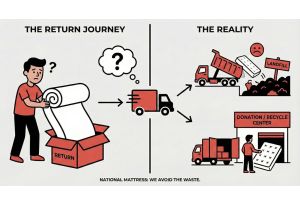
Let's follow the journey of a returned bed-in-a-box mattress:
Scenario 1: The Landfill
Most end up here. After weeks of calling charities, the frustrated customer gives up and drags the mattress to the curb. The city hauls it to the dump. Another 25+ kilograms of foam and fabric that won't decompose for decades.
According to industry estimates, Canadians throw away over 2 million mattresses every year. The bed-in-a-box return model accelerates this problem.
Scenario 2: The Liquidator
Some brands contract with third-party liquidators who pick up returned mattresses and resell them at deep discounts (often 80-90% off) through discount warehouses, online auctions, or export markets.
The original brand doesn't want you to know this exists. Why? Because if you knew you could buy the same mattress for $150 from a liquidator, you wouldn't pay $1,000 on their website.
Scenario 3: The "Donation Partner" Workaround
A few brands have arrangements with specific charities or mattress recyclers in major cities. But coverage is spotty. If you live outside Toronto, Vancouver, or Montreal, you're often on your own.
And even when pickup is available, wait times can stretch to 4-6 weeks. You're sleeping on a mattress you hate (or on the couch) while you wait for someone to take it away.
The Real Cost of "Risk-Free" Returns
Here's the math the online brands don't show you:
Industry estimates put bed-in-a-box return rates at 15-20%. Some brands see higher. That means for every 100 mattresses sold, 15-20 come back.
Each return costs the company:
- Original shipping: $100-150
- Customer acquisition (ads/affiliates): $150-200
- Processing the return: $50-100
- Total product loss: $200-400
Add it up. A single return can cost the brand $500-850 in sunk costs.
Do they eat that loss? Of course not. You do. Every customer who keeps their mattress subsidizes the ones who return. That waste is baked into the $1,000 price tag from day one.
This is why you pay double for a bed-in-a-box. Not because the mattress is better, but because the business model is broken. We broke down the full cost structure in our Mattress Math analysis.
The Environmental Disaster Nobody Talks About
Mattresses are environmental nightmares. A single queen-size mattress contains:
- 10+ kg of polyurethane foam (petroleum-based, non-biodegradable)
- Steel springs (recyclable, but rarely separated)
- Synthetic fabrics and adhesives
- Fire retardant chemicals
In a landfill, a mattress takes 80-120 years to decompose. The foam breaks into microplastics. The chemicals leach into groundwater.
The bed-in-a-box model, with its "try it and return it" philosophy, generates massive amounts of mattress waste. Every "risk-free trial" that ends in a return is another mattress that probably ends up in a landfill.
The brands market themselves as "disrupting" the old mattress industry. What they're actually disrupting is the environment.
Why National Mattress Has a 97% Keep Rate
Here's a radical idea: let people try the mattress before they buy it.
At National Mattress, you can walk into any of our locations, lie down on dozens of mattresses, and take as long as you need. Bring your partner. Bring your pillow. Roll around. We don't care.
The result? Our return rate is under 3%.
That's not because we have a stricter return policy. It's because people who test a mattress in person know what they're getting. No surprises. No "it felt firmer than I expected." No buyer's remorse.
When returns are rare, we don't need to inflate our prices to cover the waste. That savings goes directly to you and stays out of the landfill.
What to Do If You're Stuck With a Return
Already bought a bed-in-a-box and hate it? Here are your realistic options:
1. Check for Municipal Mattress Recycling
Some cities (Toronto, Vancouver, parts of the GTA) have mattress recycling programs. They'll break down the components (steel, foam, fabric) and divert them from the landfill. Google "[your city] mattress recycling" to check availability.
2. Try Smaller Local Charities
The big national charities usually say no, but smaller local organizations (immigrant settlement services, women's shelters, church groups) sometimes accept mattresses on a case-by-case basis, especially if it's clearly new or lightly used. Call and ask.
3. Sell It Yourself
Facebook Marketplace, Kijiji, Craigslist. Price it cheap ($50-100) and someone might take it off your hands within days. Be honest about condition.
4. Contact the Brand Again and Escalate
If the brand's return policy promised pickup and they're not delivering, escalate. File a complaint with the Better Business Bureau. Leave honest reviews. Contact your credit card company for a chargeback if they're not honoring the stated policy.
The Bottom Line
The bed-in-a-box "risk-free trial" isn't risk-free for anyone.
It's not risk-free for you, because you might end up stuck with a mattress nobody will take.
It's not risk-free for the planet, because millions of mattresses end up in landfills every year.
And it's not risk-free for your wallet, because you're paying $300+ extra upfront to subsidize a system that generates massive waste.
At National Mattress, we believe in a simpler model: try before you buy, pay wholesale prices, and keep waste out of the equation.
Come lie down. Find the right mattress the first time. Skip the return nightmare entirely.
Frequently Asked Questions
What happens to returned bed-in-a-box mattresses?
Most returned mattresses end up in landfills. Because shipping a used mattress back to a warehouse costs more than the mattress is worth, brands typically require customers to donate locally. When charities refuse (most do), customers often dispose of mattresses as trash. Some returns go to liquidators who resell them at steep discounts.
Why won't charities accept mattress donations?
Most charities, including the Salvation Army and Habitat for Humanity, stopped accepting used mattresses due to bed bug concerns, hygiene regulations, and liability issues. Some provinces require professional sanitization before redistributing used mattresses, which costs more than the mattresses are worth.
Do I have to donate my mattress to get a refund?
Many bed-in-a-box brands require proof of donation before processing refunds. This shifts the burden of disposal onto the customer. If you cannot find a charity to accept the mattress, you may struggle to complete the return, even within the advertised "risk-free" trial period. Always read the fine print before purchasing.
How much mattress waste do bed-in-a-box returns create?
With return rates estimated at 15-20% for online mattress brands, hundreds of thousands of mattresses are returned annually in North America. Most cannot be resold and end up in landfills, where they take 80-120 years to decompose. This waste is a hidden environmental cost of the bed-in-a-box business model.